

Qatar Renews Commitment to Supporting Counter-terrorism Efforts
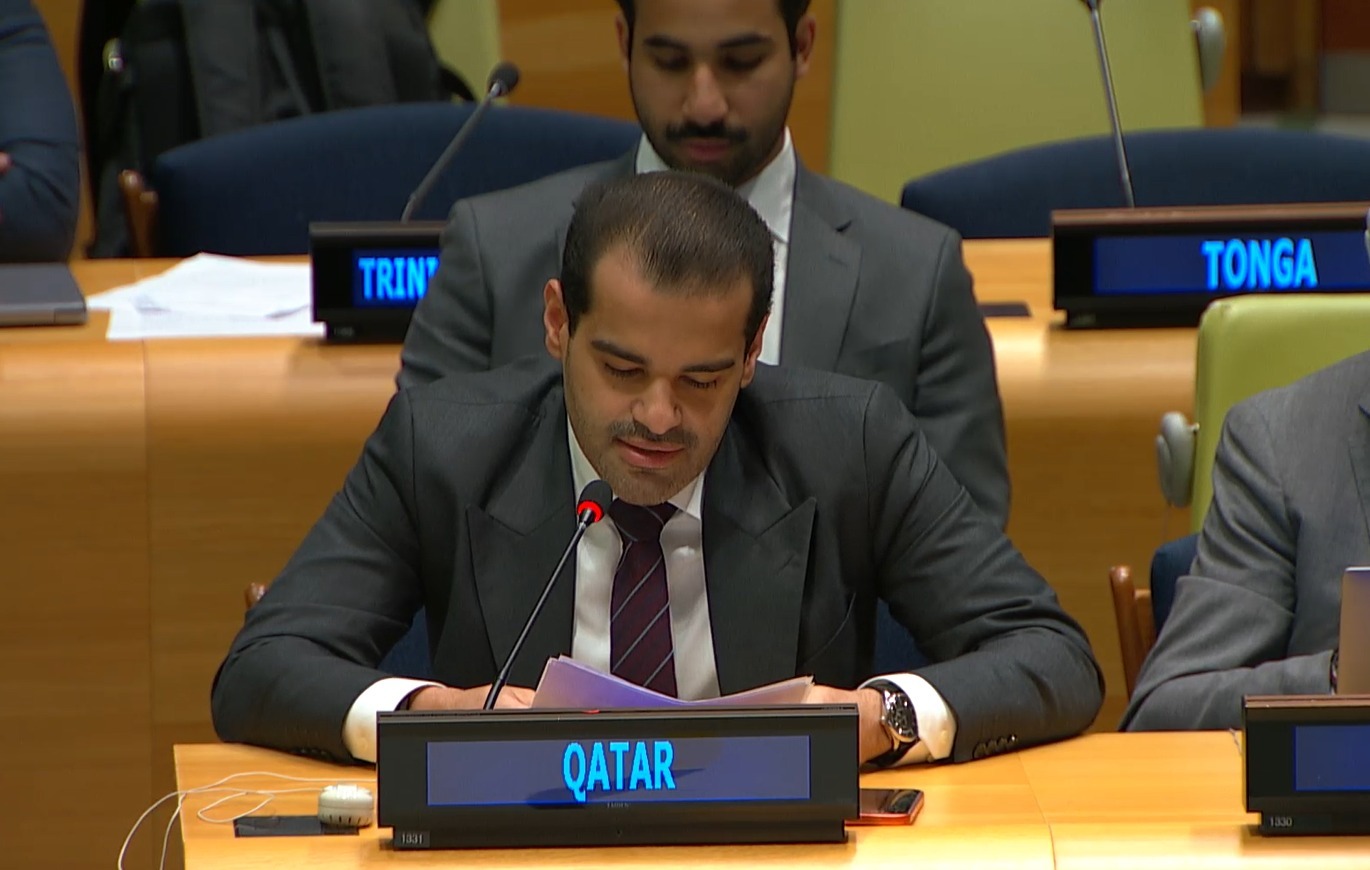
New York | October 6, 2026
The State of Qatar reaffirmed its commitment to continuing to support international efforts to combat terrorism and strengthen multilateral cooperation in a manner that contributes to addressing emerging threats and achieving international peace and security.
This came in the State of Qatar's statement delivered today by Deputy Permanent Representative of the State of Qatar to the United Nations Mohammed Khalifa Al Nasr before the Sixth Committee of the UN General Assembly during its 81st session, under agenda item 112 "Measures to Eliminate International Terrorism" at the United Nations Headquarters in New York.
Al Nasr stressed the importance of continuing consultations under the agenda item on measures to eliminate international terrorism in a manner that contributes to the progressive development of international law in this field.
He reiterated Qatar's unequivocal condemnation of terrorism in all its forms and manifestations, regardless of its motives or causes, as well as its absolute rejection of any attempt to associate terrorism with any religion, culture or people. He affirmed Qatar's position that confronting this scourge required a sincere collective commitment to the principles of international law, respect for human rights, refraining from selectivity or politicisation in counter-terrorism efforts, and ensuring that the fight against terrorism was not used as a pretext for violating rights or discriminating against peoples under occupation whose legitimate right to self-determination is guaranteed under international law.
Al Nasr welcomed, on behalf of Qatar, the outcome reached by the General Assembly in its Resolution 80/286 on the implementation of the ninth review of the United Nations Global Counter-Terrorism Strategy, reiterating Qatar's full commitment to implementing the Strategy's provisions, objectives and principles.
The Deputy Permanent Representative of Qatar to the United Nations stressed the importance of completing the international legal framework for combating terrorism. He noted that Qatar called for intensified efforts to reach consensus on the draft Comprehensive Convention on International Terrorism in a manner that addresses outstanding issues in accordance with the principles of international law.
Al Nasr said that, at the national level, Qatar had adopted a comprehensive and multidimensional approach to combating terrorism, combining national legislation, capacity-building, and international and regional cooperation.
He noted that Qatar continued to strengthen its legislative and institutional framework, including measures to combat terrorist financing. It had also adopted a comprehensive national strategy to combat terrorism and violent extremism, aligned with the UN Global Counter-Terrorism Strategy and centred on prevention, protection, prosecution and recovery. The strategy is implemented by the National Counter-Terrorism Committee in coordination with the relevant national authorities.
At the international level, Al Nasr said Qatar was proud to be a key partner of the United Nations Office of Counter-Terrorism (UNOCT) and the largest contributor to the UN Trust Fund for Counter-Terrorism since 2019, with contributions exceeding USD 142 million and accounting for approximately one-third of contributions to the Fund. He noted that this support had enabled the Office to implement long-term projects and distinguished global programmes covering the various pillars of the Global Counter-Terrorism Strategy.
The Deputy Permanent Representative expressed Qatar's pride in hosting one of the five programme offices of the UNOCT. He said work was underway to expand the Doha Programme Office to include several programmes and activities, making it the Office's largest field presence outside UN Headquarters and helping improve the delivery of capacity-building assistance and bring the Office's activities closer to beneficiaries.
He noted that Qatar actively cooperated with other entities contributing to the implementation of the United Nations counter-terrorism mandate, particularly the Counter-Terrorism Committee Executive Directorate and the Analytical Support and Sanctions Monitoring Team.
Al Nasr said Qatar attached importance to multilateral counter-terrorism forums, continuing its role as an active member of the Global Coalition to Defeat ISIS. He added that Qatar also supported regional efforts within the framework of the League of Arab States and the Gulf Cooperation Council through information-sharing and close coordination to address common terrorist threats.