

Minister of State at Ministry of Foreign Affairs Participates in GLOBSEC Forum 2026 in Prague
Prague, May 21, 2026
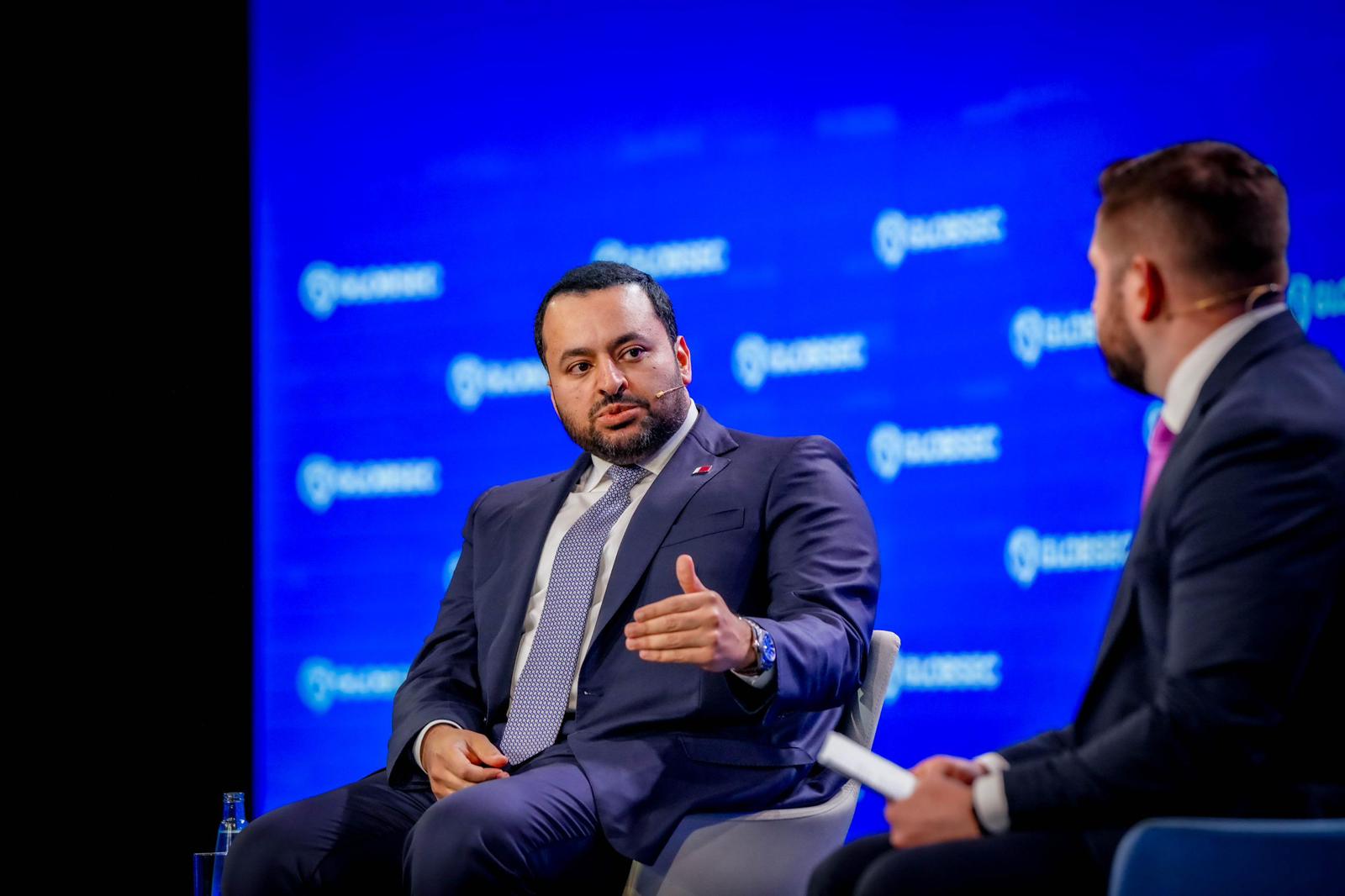
HE Minister of State at the Ministry of Foreign Affairs Dr. Mohammed bin Abdulaziz bin Saleh Al Khulaifi participated Thursday in GLOBSEC Forum 2026, held in Prague, Czech Republic.
In his remarks during a keynote session titled "Seeking Peace in the Middle East and Beyond," His Excellency said that we are living in a moment where conflicts are no longer confined to their geographical scope. War produces humanitarian, economic, political, security and social consequences that far exceed its geographical boundaries.
His Excellency stressed that mediation for the State of Qatar is not a temporary political option, but rather a part of its national identity and foreign policy. He noted that Article 7 of the Constitution of the State of Qatar obliges it to support efforts for the peaceful settlement of international disputes. He pointed out that the State of Qatar has been engaged for many years in dialogue, facilitation and mediation in Gaza, Afghanistan, Iran, Lebanon, Sudan, Chad, Venezuela, Ukraine and recently in many other regions.
His Excellency added that Qatar's approach is quite simple: we don’t engage in mediation because it's easy, but because the alternative is often worse. He added that the mediator's role will never be insignificant in making a difference if the process has the trust of the parties.
Regarding the cascading repercussions of the ongoing conflicts, HE the Minister of State at the Ministry of Foreign Affairs said that the first impact is the humanitarian collapse, as conflicts today produce displacement, hunger, trauma, hostage-taking, family separation, and the destruction of civilian infrastructure.
His Excellency pointed out that in Gaza, for example, the humanitarian dimension is not secondary to diplomacy, but rather its essence, stressing that international efforts must move to enable access to humanitarian aid and protect civilians simultaneously.
His Excellency indicated that the second effect lies in regional escalation, as conflicts rarely remain local. He added that this is especially true in the Middle East, where a single crisis can quickly affect the Gulf, the Red Sea, the Levant and beyond.
His Excellency identified the fourth impact as global economic pressure, noting that conflicts affect energy and food supplies, investment, aviation, maritime security, and migration. He emphasized that peacemaking is not only a moral obligation but also a strategic necessity.
HE the Minister of State at the Ministry of Foreign Affairs said that Qatar's experience has shown that even limited agreements - such as a ceasefire, a humanitarian truce, the release of detainees or the opening of a communication channel - can prevent the expansion of the conflict.
Responding to a question about which diplomatic tools can best promote stability and peace, HE the Minister of State at the Ministry of Foreign Affairs said that the first tool is reliable communication channels. He noted that in many conflicts, the parties cannot communicate directly, or do not trust each other, and the first task of the mediator is not to impose a solution directly, but to make communication possible.
His Excellency indicated that the second tool is humanitarian diplomacy. He pointed that sometimes political peace is not immediately possible, but humanitarian progress can be achieved, and that the release of civilians, medical evacuations, humanitarian access, or family reunification can create trust and reduce the risk of conflict.
His Excellency pointed out that the fourth tool is partnership, adding that Qatar rarely works alone. In Gaza, Qatar worked closely with Egypt, Turkiye, and the United States in efforts to reach a ceasefire and finalize humanitarian arrangements.
His Excellency underscored that the fifth tool is realistic sequencing, where mediators must know when to seek a comprehensive agreement and when to start with a smaller step. In mediation, a small humanitarian success can become the first building block in a larger political process.
Response to a question on how alliances and partnerships can support peacebuilding, His Excellency pointed out that partnerships are essential because no mediator can achieve peace alone. He indicated that a mediator can open doors, build trust, and propose options, but sustainable peace requires political will from the parties and continuous support from regional and international partners.
His Excellency said that partnerships can support peacebuilding across four dimensions: political support, humanitarian support, security guarantees, and post-agreement investment, because peace without reconstruction, jobs, and institutions remains fragile.
His Excellency stressed that mediation can open the door to peace, but partnerships are what prevent that door from closing again.
His Excellency explained that Qatar does not claim that mediation resolves every conflict; it does not. However, without serious mediation, many conflicts become longer, more violent, and more difficult to resolve. He pointed out that the world today does not suffer from an abundance of diplomatic efforts, but rather from a lack of patience, a lack of trust, and a lack of investment in lasting, peaceful solutions.