

Advisor to Prime Minister and Ministry of Foreign Affairs Spokesperson: Qatar Supports Mediation, Prepared for All Contingencies
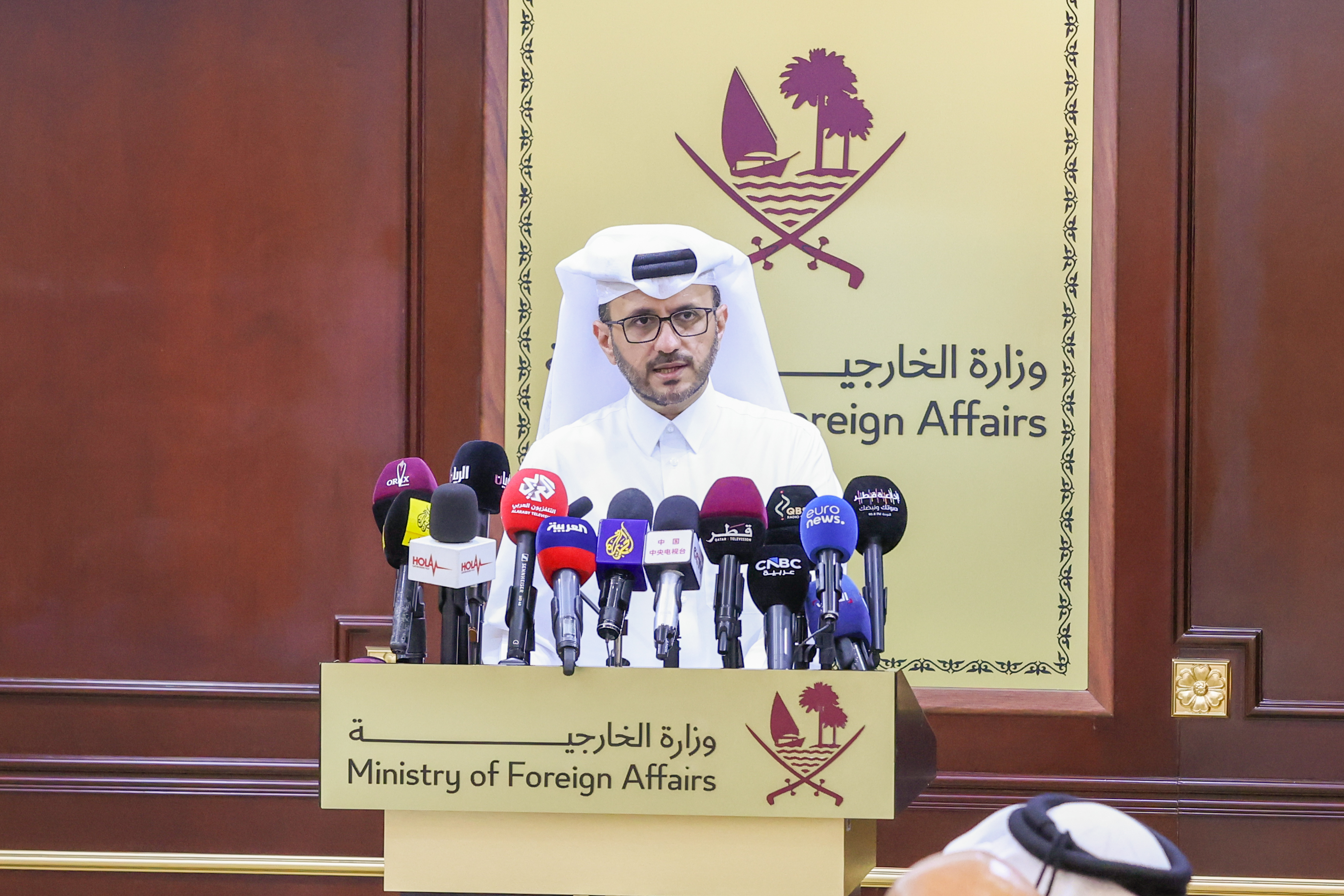
Doha | April 7, 2026
Advisor to the Prime Minister and Official Spokesperson for the
Ministry of Foreign Affairs Dr. Majed bin Mohammed Al Ansari reaffirmed that
the State of Qatar’s position regarding mediation has not changed, noting its
full support for the ongoing mediation efforts led by the Islamic Republic of
Pakistan, despite the State of Qatar not being directly involved due to its
focus on self-defense amid escalating threats in the region and continued
Iranian attacks.
Speaking during the
Ministry of Foreign Affairs’ weekly press briefing, Al Ansari said that the
State of Qatar was prepared for all contingencies, adding that the country has
previously overcome even greater challenges and that there was full confidence
in the leadership to take all necessary measures to ensure the stability of its
markets and economy.
He added that the State of
Qatar strongly condemns all Iranian violations of national sovereignty in the
region, noting that these attacks, which include targeting civilian
infrastructure and energy facilities, represent a dangerous escalation that
does not contribute to resolving the crisis but instead complicates it and
introduces new challenges for the region.
He noted that the Qatari
armed forces have dealt in recent days with Iranian attacks, including drones,
affirming the country was fully ready to handle any potential scenarios and to
respond to any escalation or further hostile actions.
The Advisor to the Prime
Minister and Official Spokesperson for the Ministry of Foreign Affairs
explained that Qatar’s communications with various parties, including the
United States and Iran, have focused on warning against the dangers of
targeting infrastructure, noting that such attacks negatively affect the
peoples of the region, the global economy, and energy markets, and yield no
gains for any party involved in the conflict.
Regarding the Strait of
Hormuz, he said that its closure constitutes a dangerous precedent and a clear
violation of international law, and a direct threat to global security, supply
chains, energy, and food.
He stressed that the
strait was a shared natural waterway that cannot be used as a tool of political
pressure, calling for its immediate and safe reopening and ensuring freedom of
navigation without any threats.
On Qatari gas carriers, Al
Ansari said that all countries in the region and many international partners
were suffering due to the closure of the strait, emphasizing that the State of
Qatar’s priority in this regard was the safety of those working on these
vessels and ensuring they were not exposed to danger in the absence of a clear
mechanism for safe passage.
He added that the closure
of the strait in this manner constituted not only a violation of international
law but also a disruption of global supply chains, and a threat to global
energy and food industries, stressing that this would not serve any party nor
resolve any crisis.
Regarding calls for
guarantees to reopen the Strait of Hormuz, Al Ansari emphasized that the
decision to reopen it must be clear and not subject to political calculations,
stressing that the countries of the region share this strait and no single
party can claim exclusive control over it under any justification, whether
through legal interpretations or the imposition of fees.
He added that the Strait
of Hormuz was not like the Panama Canal or the Suez Canal, which were under the
authority of specific states, but is a naturally open strait through which all
ships and vessels pass, noting that there had never previously been a need for
such measures, as ships had always passed through it normally.
Advisor to the Prime
Minister and Official Spokesperson for the Ministry of Foreign Affairs Dr.
Majid bin Mohammed Al Ansari indicated that the Gulf and Arab states, along
with friendly countries, were continuously coordinating with international
partners regarding ongoing developments, including stances in the Security
Council.
He stressed that any
future agreement must be based on a comprehensive regional consensus, have
international guarantees, and be based on respect for international law, with
the involvement of all concerned and affected parties to the conflict in its
formulation.
He pointed out that the
current crisis was no longer just regional, but has become a global crisis
affecting the international economy and global security and peace, which calls
for intensifying international efforts to prevent further escalation,
especially in light of the expiration of the deadline set by the US
administration to reach an agreement with Iran before any further escalation.
He reiterated that the
only solution to the crisis is through a political process and a return to the
negotiating table, stressing Qatar's rejection of all forms of targeting
civilians and vital facilities in any country, and renewing Qatar's call for
de-escalation and the preservation of the region's security and stability.
Al Ansari indicated that
the priorities of the State of Qatar are in line with the priorities of the
countries of the region, especially reaching a sustainable political solution
that takes into account the interests of the peoples of the region, avoiding
partial solutions, and reaching a solution that establishes a new regional
security system based on cooperation, consensus and international guarantees,
in order to ensure the stability and security of the region in the long term.
He added that any solution
must take into account the red lines that have been crossed during this war,
including the threat to maritime navigation through the Strait of Hormuz, which
cannot be part of any future solution, and no single party can have the ability
to close this strait, or be allowed to continue to have this advantage in
regional dealings, and no party can have the ability to threaten the other in
this way without a clear deterrent.
He reiterated that any
future agreement must include a clear regional role, stressing that this region
must be managed first through the priorities of its countries, and then
according to the priorities of global security and peace.
In a related context, the
Advisor to the Prime Minister and Official Spokesperson for the Ministry of
Foreign Affairs warned against attempts by the Israeli occupation to take
advantage of the international community's preoccupation with this war to
impose new realities and change the internationally agreed-upon status quo,
especially about the Al Aqsa Mosque and the West Bank, as well as the
implementation of the agreement in the Gaza Strip.
He said that these
attempts are shameful and aim to circumvent international agreements and
international law.
They are also an attempt
to impose a reality that will emerge from this war with historical
transformations that will be negative towards the region.
Dr. Al Ansari added that
the State of Qatar's stance on this matter was clear since day one, reflected
in the series of statements condemning the occupation's practices, whether in
the West Bank, toward Al Aqsa Mosque, or in the Gaza Strip, warning against
exploiting the current situation and taking advantage of the preoccupation of
all countries in the region with the war, in which Israel is a party, to impose
a new reality.
Al Ansari concluded the media briefing by saying that whoever wants peace in the region must start with the option of peace, not with war, with the expectation that it will lead to peace. This threat will be a threat to all countries in the region, including the Israeli people, who will be the first victims of the region's departure from the circle of international agreements.