

UNHRC Adopts Resolution on Human Rights Implications of Iran's Unprovoked Attacks on GCC Nations, Jordan
Geneva, March 25, 2026
The UN Human Rights Council (UNHRC) on Wednesday ratified, without a vote, the submitted resolution on the human rights implications of the unprovoked attacks waged by the Islamic Republic of Iran on the State of Qatar, the United Arab Emirates, the Kingdom of Saudi Arabia, the Kingdom of Bahrain, the Sultanate of Oman, the State of Kuwait, and the Hashemite Kingdom of Jordan.
The resolution in question was co-sponsored by more than 100 countries.
Earlier, the State of Qatar had expressed its strong condemnation of the missile and drone attacks the Islamic Republic of Iran launched and targeted at Qatari territory. It considered these offensives as a flagrant violation of its national sovereignty and territorial integrity, and an outright breach of the principles of the Charter of the United Nations, in particular the prohibition of the threat or use of force.
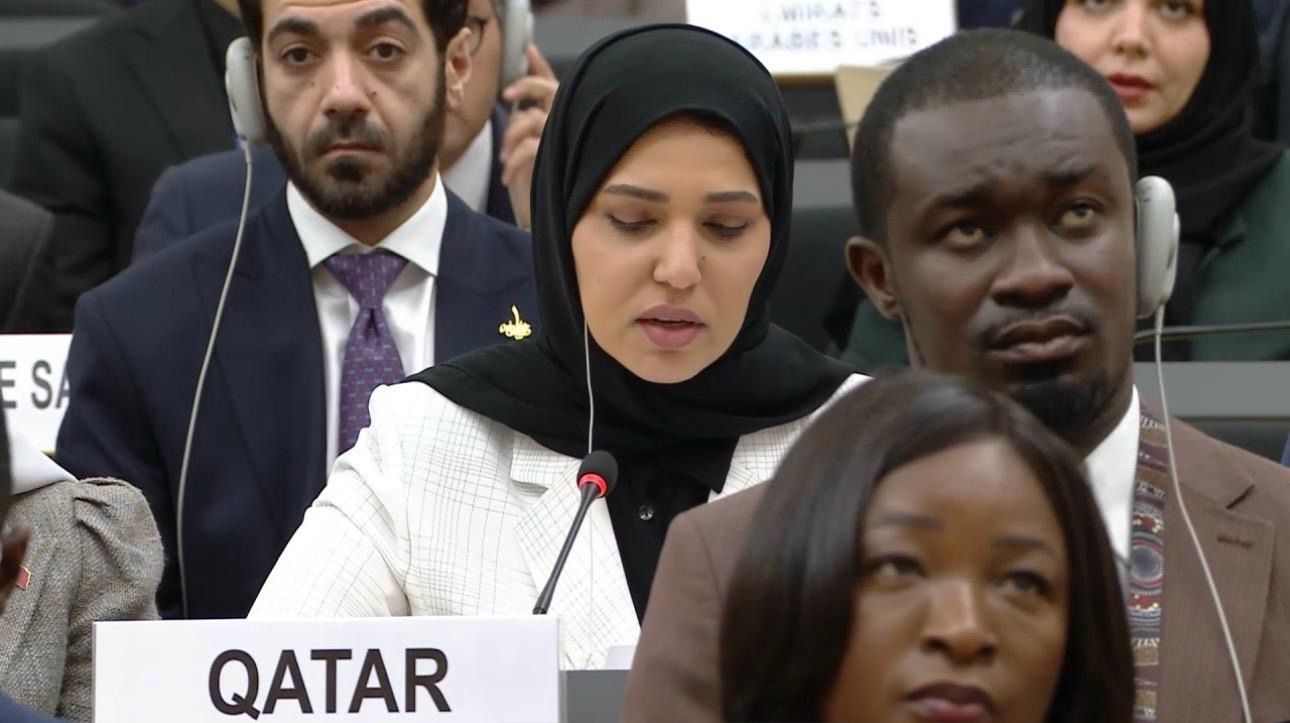
The statement of Qatar was delivered by HE Permanent Representative to the United Nations Office in Geneva, Dr. Hind Abdulrahman Al Muftah, during her engagement in the urgent debate convened by the Human Rights Council over the implications of the unprovoked attacks on the State of Qatar, the United Arab Emirates, the Kingdom of Saudi Arabia, the Kingdom of Bahrain, the Sultanate of Oman, the State of Kuwait, and the Hashemite Kingdom of Jordan.
This debate convenes in an extremely perilous circumstance in the wake of the unprovoked attacks Iran wages on the GCC nations and Jordan, along with their menacing ripple effects that not only compromise global peace and security but also undermine the full enjoyment of human rights, HE Al Muftah underlined.
She stressed that these indiscriminate attacks targeting civilians and civilian objects gravely run afoul of international law, including international humanitarian law and international human rights law.
Al Muftah further noted that critical facilities had been targeted, such as airports, ports, energy facilities, and water desalination plants, reemphasizing that such acts not only pose a threat to regional security but also amount to a direct assault on many upheld fundamental rights in accordance with international human rights law.
The perpetuation of these attacks raises profound consternation that must not be overlooked, Al Muftah recalled, confirming that the State of Qatar came under ballistic missile and drone attacks that caused losses and injuries among civilians, as well as disruption of basic services and water and energy supplies, in a brazen violation of the rights to life, health, education, and safety.
Her Excellency outlined that targeting energy and water desalination facilities and the ensuing perilous ecological consequences compromise the right to a safe, clean, healthy, and sustainable environment, as upheld by the Human Rights Council.
These violations overtly aggravate the situation among the most vulnerable groups, including women, children, the elderly, and persons with disabilities, in an unequivocal contravention of international obligations to protect them, particularly the Conventions on the Rights of the Child and the Rights of Persons with Disabilities, she noted.
Al Muftah further highlighted that targeting critical facilities and maritime shipping lanes, namely the Strait of Hormuz, raises profound apprehension, as this act would definitely have far-reaching consequences on the global economy, supply chains, and energy security.
This kind of act would adversely impact the enjoyment of socioeconomic rights and the right to development in numerous countries, especially developed ones, Al Muftah underscored, asserting that protecting civilian infrastructure and ensuring freedom of international navigation constitute a legal and moral obligation that should never be compromised.
Al Muftah elaborated that targeting the State of Qatar's territory does not align with the ethos of good neighborliness and is utterly unprovoked under all circumstances, as Qatar has been pursuing an enduring approach in supporting peaceful dialogue and mediation as an offramp for dispute settlement.
Al Muftah pointed out that targeting the territory of a nation not party to the conflict, and which has never allowed its territory and airspace to be used in combat operations, amounts to a dangerous violation of international law and negatively affects global peace and security, as well as the enjoyment of fundamental rights.
The State of Qatar has distanced itself from this war since its beginning and has been careful not to engage in any escalation. However, the Iranian side insists on targeting it and neighboring countries in an irresponsible approach that undermines regional security and imperils international peace, Al Muftah stressed.
She recalled that Qatar accordingly upholds the enduring right of nations to defend themselves based on Article (51) of the UN Charter, in line with the international rules-based order.
In addition, the Qatari representative welcomed Security Council Resolution 2817 (2026), which strongly condemned the serious attacks waged by the Islamic Republic of Iran against the Arab Gulf States and Jordan, and determined that these acts constitute a violation of international law and a serious threat to international peace and security.
She emphasized the criticality of providing effective remedies, including full and fair reparation for victims and affected countries.
Her Excellency underlined that human rights, peace, security, and development are interlinked components, and any compromise of one of them adversely affects the others. She noted that crisis remediation requires an overall approach that is laser-focused on de-escalation, respecting international law, and boosting peaceful solutions.
Al Muftah recalled that the State of Qatar calls for an immediate halt to this escalation, pursuing the diplomatic path and giving dialogue overriding priority to safeguard the region's security and stability, in addition to protecting human rights and dignity.
She likewise called on the member states at the Human Rights Council to ratify the submitted resolution when this urgent debate wraps up, confirming the importance of protecting human rights and taking further action to stop and prevent violations arising from the attacks, as well as ensuring they do not recur.