

Doha Forum 2025: Minister of State at Foreign Ministry Says Mediation is Foundational Pillar in Qatar's Foreign Policy
Doha, December 07, 2025
HE Minister of State at the Ministry of Foreign Affairs, Dr. Mohammed bin Abdulaziz bin Saleh Al Khulaifi stressed that mediation constitutes a foundational pillar of Qatar's foreign policy. He noted that, at the request of many of its friends and partners worldwide, Qatar has assumed the role of mediator in resolving a wide array of regional and international conflicts.
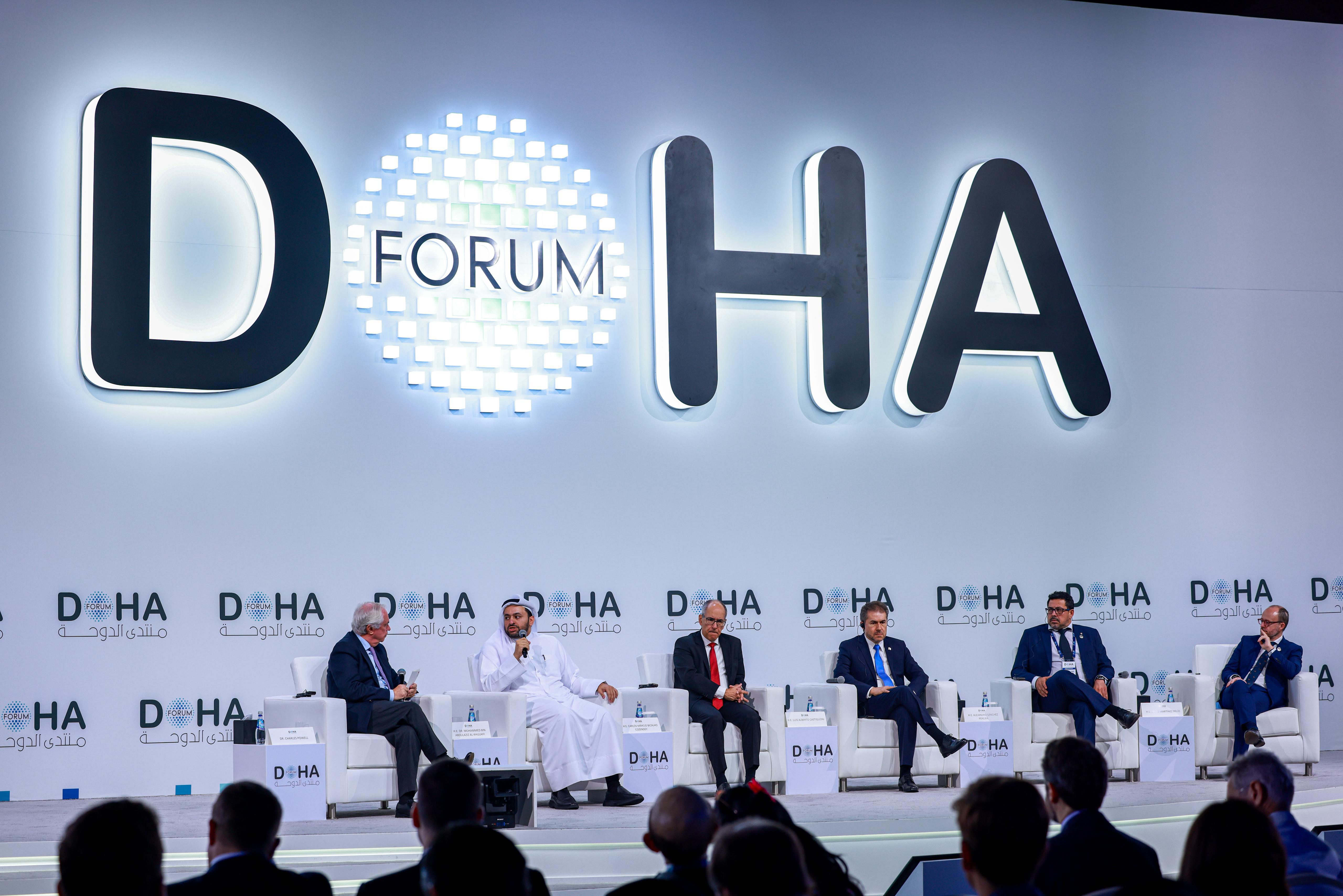
Speaking during a session titled "Global Governance and Multilateralism, Global South Cooperation: Paths to Prosperity in Latin America: The Role of Cross-Regional Diplomacy" at the Doha Forum 2025, he remarked that Qatar's approach to mediation is characterized by its disregard for geographical boundaries. Its efforts, he explained, span east to west, encompassing even the most complex disputes, driven by Qatar's firm conviction in the importance of building bridges and narrowing divides between warring parties.
He underscored that, despite the inherent challenges of mediation, Qatar has succeeded in entrenching the principles of neutrality and confidence-building while devising innovative initiatives that bring disputing parties to the negotiating table.
Among Qatar's most sensitive and intricate responsibilities, His Excellency added, is its mediation between Palestinians and Israelis - an issue that consistently ranks among the world's most complex and delicate.
Regarding Qatar's mediation efforts in Latin America, His Excellency emphasized that this orientation reflects a strategic policy. He noted that over the past four years, Qatar has mediated in several matters, including its successful facilitation between the US and Venezuela, which culminated in a prisoner exchange in 2023, which further strengthened Qatar's standing and reputation across Latin America.
He continued that Qatar's pivotal role has led to an increasing number of requests for its involvement as a mediator. In this context, he referred to Qatar's recent mediation in Colombia, conducted in partnership with Norway, Spain, and Switzerland. He recalled Qatar's announcement last week that the Colombian government and the self-declared EGC group had signed a "Commitment to Peace" following two rounds of talks held in Doha - an agreement he said reflects a spirit of responsibility and mutual understanding, helps alleviate the suffering of civilians, and opens a credible pathway toward sustainable peace.
He also highlighted the Ministry of Foreign Affairs' appreciation for the constructive attitude demonstrated by both parties during the rounds of mediation. The Ministry, he noted, reaffirmed the importance of full implementation of the agreement, acknowledged the contributions of international partners - particularly Norway, Spain, and Switzerland - and expressed gratitude for their support of this process.
HE Dr. Al Khulaifi explained that the concept of transnational diplomacy has become indispensable in today's world, as many parties are unable to resolve their conflicts within local frameworks. This reality, he observed, makes reliance on internationally trusted partners essential for successful mediation - a principle at the heart of Qatar's partnerships in this field, especially in Latin America.
He stressed that there is no single mediation model that applies to all conflicts; each situation differs in its nature, actors, and context. He added that Qatar has built up more than 25 years of experience mediating disputes across diverse cultural and geographic settings, citing, as one example, Qatar's mediation between the United States and the Taliban that resulted in the 2020 agreement.
HE the Minister of State at the Ministry of Foreign Affairs affirmed that a mediator's role centers on bringing parties closer together and assisting them in implementing and sustaining agreements, praising Qatar's partnerships with friendly nations - including Norway, Switzerland, and Spain - which support international mediation efforts.
He also recalled that Qatar has signed several memoranda of understanding and letters of intent related to mediation, convinced that the complexity of contemporary conflicts often necessitates cooperation among multiple mediators to achieve effective and lasting outcomes.
He observed that peace does not signify the complete absence of conflict, but rather the capacity to manage and address disputes through structured frameworks that enable mediators to perform their roles efficiently. He noted that the momentum Qatar has generated in Latin America has encouraged additional countries in the region to reach out and seek its support in mediation initiatives.
Concluding his remarks, HE Minister of State at the Ministry of Foreign Affairs, Dr. Mohammed bin Abdulaziz bin Saleh Al Khulaifi affirmed that Qatar will continue to play its mediating role by maintaining open channels of communication with all parties - states and non-state actors alike - in pursuit of sustainable solutions that prioritize humanitarian considerations and contribute to ending conflicts and building lasting peace.